
June 2026 • 8 min read
Suriname’s Emerging Energy Economy: What Local Businesses Should Be Doing Right Now
For many business owners in Suriname, the growing conversation around offshore oil and gas still feels like something happening offshore—literally and figuratively.
It sits in the background of daily operations. For a restaurant owner in Paramaribo, a logistics operator moving goods across the country, or a construction contractor focused on small to mid-size projects, it is easy to assume that the energy sector is a world reserved for multinational oil companies and highly specialized engineering firms.
But that assumption has already been proven wrong next door.
Just look at Guyana.
What happened there over the last few years was not just an oil story—it was an economic restructuring. And more importantly, it was not only the oil companies that benefited. It was everyone who was ready early enough to adapt.
Suriname is now standing at a similar starting point. The difference is that there is still time to prepare.
What Guyana Teaches Us About Oil-Driven Economies
Guyana’s experience offers a practical lesson that many business owners overlook at first:
Oil and gas do not grow an industry in isolation—they expand an entire economy around it.
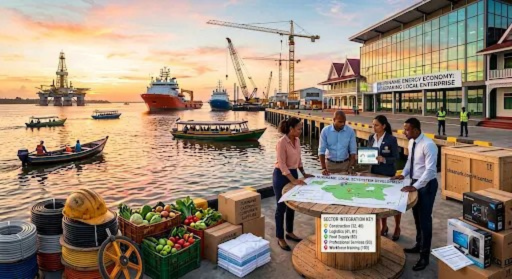
For every offshore operation, there is a massive onshore ecosystem quietly forming behind it. Workers need housing. Companies need offices. Equipment needs transport. Food needs to be supplied daily. Security must be maintained. Training must be delivered continuously.
And none of that is handled solely by oil companies.In Guyana, this ripple effect created opportunities for businesses that had nothing to do with drilling or exploration. Construction firms expanded. Small hotels turned into long-term accommodation providers. Local transporters became essential logistics partners. Even farmers and caterers found steady corporate demand.
The key difference between those who benefited and those who didn’t was timing.
Those who prepared early grew with the market. Those who waited often found themselves competing against larger, more organized players who had already moved in.
Suriname now has something valuable: foresight.
If there is one sector that feels the impact first in an emerging energy economy, it is construction.
Before any oil flows, physical infrastructure must be built—offices, storage facilities, roads, worker accommodations, ports, and industrial support structures.
This creates a widening space for:
- Civil and building contractors
- Electrical and mechanical contractors
- Plumbing and HVAC specialists
- Steel fabricators and suppliers
- Interior and fit-out companies
- Material and equipment suppliers
What is important here is not just scale—it is transition. Even small and mid-sized construction firms that currently focus on residential or commercial projects may find themselves stepping into industrial-grade work over time.
But that shift requires preparation, not reaction.
Logistics: The System That Keeps Everything Moving
Behind every major project is a system most people do not see: logistics.If construction is the visible structure, logistics is what makes it possible.
As energy activity increases, the movement of goods, equipment, and personnel becomes constant and complex. This is where local logistics businesses can play a major role.
Potential opportunities include:
-
- Trucking and transport operators
-
- Freight and shipping coordinators
-
- Customs and clearance agents
-
- Warehousing and storage providers
-
- Fleet management companies
-
- Vehicle rental and leasing services
In Guyana, logistics providers that upgraded their systems, compliance, and fleet capacity early were able to secure long-term contracts. Others struggled to keep up once demand accelerated.
The same pattern is likely to repeat in Suriname.
Hospitality and Services: The Quiet Growth Sector
Not all energy-related growth looks industrial. One of the most underestimated sectors in oil-driven economies is hospitality.
As international professionals arrive—engineers, consultants, project managers, technical teams—they need places to stay, eat, and operate from. Often for months at a time.
This creates sustained demand for:
-
- Hotels and guesthouses
-
- Restaurants and catering services
-
- Laundry and housekeeping businesses
-
- Event and conferencing services
-
- Transport providers
A local restaurant may not immediately think of itself as part of the energy economy. But corporate catering contracts or long-term accommodation partnerships can quietly become some of the most stable income streams during an economic expansion cycle.
Training and Workforce Development: Building the Human Foundation
Every growing industry eventually runs into the same limitation: people.
As the energy sector expands, demand for trained local workers increases significantly. This is not just about engineers or technicians—it extends across safety, operations, administration, and support services.
Opportunities will grow for:
-
- Technical and vocational training institutes
-
- Safety and compliance training providers
-
- Leadership and management programs
-
- English and communication training
-
- Digital and IT skill development
Countries that benefit most from resource-driven growth are often the ones that invest early in people, not just infrastructure.
Technology: The Invisible Backbone of Energy Operations
Modern energy projects are deeply dependent on technology systems.
From communication networks to cybersecurity, data management, and operational software, the digital layer is just as important as the physical one.
This opens doors for:
-
- IT service providers
-
- Software development firms
-
- Cybersecurity specialists
-
- Telecommunications providers
-
- Digital transformation consultants
The opportunity here is not just technical—it is strategic. Local tech companies that build capability early can position themselves as long-term partners, not just service vendors.
Professional Services: Where Complexity Creates Demand
As economies grow, complexity follows.
And where complexity increases, so does the need for professional support.
Law firms, accountants, consultants, insurance providers, and HR specialists all become essential parts of the ecosystem.
This includes:
-
- Accounting and auditing services
-
- Legal and compliance advisory
-
- Tax and regulatory consultants
-
- Insurance and risk management firms
-
- Business development advisors
Energy-related industries often require specialized knowledge. Local firms that start building that expertise now will be better positioned when demand increases.
Agriculture and Food Supply: The Link Most People Miss
At first glance, agriculture may seem far removed from oil and gas.
But in reality, it is one of the most important supporting sectors.
A growing workforce means increased demand for consistent food supply chains. This benefit:
-
- Farmers and produce suppliers
-
- Food processing companies
-
- Beverage distributors
-
- Cold storage and logistics providers
-
- Commercial catering businesses
Reliable local supply chains often become preferred partners in large projects, especially when consistency and speed matter more than imports.
Health, Safety, and Environmental Services: A Critical Requirement
As industrial activity increases, so does regulation, responsibility, and risk management.
This creates strong demand for:
-
- Security service providers
-
- Occupational health and safety firms
-
- Emergency medical services
-
- Fire and rescue support
-
- Environmental compliance consultants
-
- Waste and water management companies
These are not optional services—they are mandatory components of any serious industrial operation.
The Real Message for Business Owners in Suriname
The most important takeaway is simple, but often overlooked:
You do not need to become part of the oil industry to benefit from it.
You only need to understand where your business fits into the wider ecosystem that oil and gas creates.
That requires preparation:
-
- Improving operational standards
-
- Investing in staff capability
-
- Strengthening compliance and safety systems
-
- Building partnerships early
-
- Positioning for vendor registration and contracts
The businesses that benefit most will not necessarily be the largest. They will be the ones that adapt the fastest.
Looking Forward
Suriname is not just entering an energy phase—it is entering an economic transition.
Oil and gas may be the headline, but the real story is broader: thousands of local businesses finding new roles in a rapidly expanding economy.
Construction firms, logistics providers, hospitality operators, tech companies, farmers, consultants—each will play a part in shaping what this growth becomes.
The opportunity is not distant. It is already forming.
And in moments like this, timing matters more than size.
Shaanark Ventures works with businesses, entrepreneurs, and institutions to prepare for emerging opportunities in Suriname’s energy economy through strategy, training, and business development support. Contact us today! Website: https://shaanark.com/#/contact