
June 2026 • 8 min read
Legacy Systems vs Modern Systems: Why Digital Transformation Can No Longer Wait
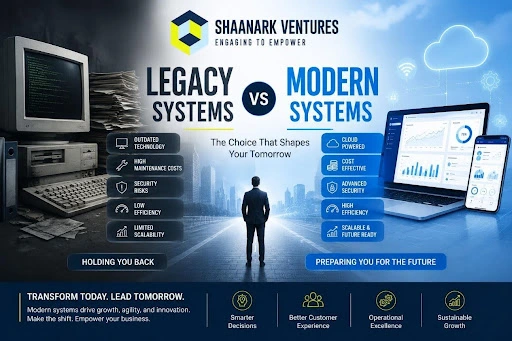
Technology has become the backbone of modern business. From managing customer relationships and employee records to processing transactions and analyzing data, organizations rely on technology to keep operations running efficiently. Yet many businesses continue to depend on legacy systems—outdated software, aging infrastructure, and disconnected processes that were once effective but now limit growth.
While these systems may still function, they often create operational bottlenecks, increase maintenance costs, expose businesses to security risks, and prevent organizations from taking advantage of modern innovations such as cloud computing, automation, artificial intelligence (AI), and real-time analytics.
In today’s fast-moving digital economy, businesses that hesitate to modernize risk falling behind competitors who can adapt more quickly, make better decisions, and deliver superior customer experiences.
This article explores the differences between legacy and modern systems, the challenges organizations face when relying on outdated technology, and why digital transformation is no longer optional for businesses that want to remain competitive.
What Are Legacy Systems?
A legacy system refers to software, hardware, or technology infrastructure that has been in use for many years and continues to support business operations despite being outdated.
Legacy systems are common across industries because they often contain years of valuable business data and perform mission-critical functions. Many organizations continue using them simply because replacing them seems expensive, complicated, or risky.
Examples include:
- Old accounting software
- On-premise ERP systems
- Spreadsheet-driven operations
- Paper-based approval processes
- Legacy HR management software
- Older customer databases
- Standalone desktop applications
Although these systems may still function, they often struggle to meet modern business requirements.
What Are Modern Business Systems?
Modern systems are designed to support today’s digital workplace. They leverage cloud technology, automation, artificial intelligence, mobile accessibility, and integrated platforms to improve efficiency and business agility.
Examples include:
- Cloud-based ERP solutions
- Customer Relationship Management (CRM) platforms
- Human Resource Information Systems (HRIS)
- Workflow automation tools
- AI-powered business applications
- Business intelligence dashboards
- Cloud collaboration platforms
Rather than operating in isolation, modern systems integrate multiple business functions into a single connected ecosystem.
This allows employees to access information faster, collaborate more effectively, and make informed decisions based on real-time data.
The Hidden Costs of Legacy Systems
Many businesses continue using legacy systems because they appear to save money by avoiding replacement costs.
However, outdated technology often creates significant hidden expenses.
High Maintenance Costs
Older systems require constant maintenance, specialized technical expertise, and expensive hardware support.
As vendors discontinue support, businesses often struggle to find professionals capable of maintaining aging software.
Maintenance costs gradually increase while system performance declines.
Reduced Productivity
Employees frequently spend valuable time performing manual tasks that modern systems automate.
Examples include:
- Duplicate data entry
- Manual reporting
- Spreadsheet consolidation
- Email approvals
- Paper documentation
These repetitive processes reduce productivity and increase the likelihood of human error.
Security Risks
Cybersecurity threats continue evolving every year.
Legacy systems often lack:
- Security updates
- Multi-factor authentication
- Modern encryption
- Threat monitoring
- Cloud backup capabilities
This leaves organizations vulnerable to cyberattacks, ransomware, and data breaches.
Protecting sensitive customer and business information has become a strategic necessity rather than an IT responsibility alone.
Poor Customer Experience
Today’s customers expect speed, accuracy, and convenience.
Outdated systems frequently result in:
- Slow response times
- Delayed order processing
- Inconsistent customer information
- Limited online services
- Poor communication
Customer expectations continue rising, making modern technology essential for delivering exceptional experiences.
Advantages of Modern Business Systems
Modern technology is designed to improve both operational efficiency and strategic decision-making.
Improved Efficiency
Automation reduces repetitive work by streamlining everyday business processes.
Tasks such as invoice processing, employee onboarding, customer support, document approvals, and payroll management can all be automated.
This allows employees to focus on higher-value activities rather than administrative work.
Better Decision-Making
Modern systems provide real-time dashboards and analytics.
Business leaders can instantly monitor:
- Sales performance
- Financial reports
- Employee productivity
- Customer satisfaction
- Inventory levels
- Project progress
Instead of waiting for monthly reports, executives gain immediate visibility into business performance.
Data-driven decision-making improves accuracy and responsiveness.
Scalability
As businesses grow, technology must grow alongside them.
Modern cloud-based systems allow organizations to:
- Add new users easily
- Expand into new locations
- Integrate additional software
- Increase storage
- Support remote teams
Businesses no longer need expensive hardware upgrades every few years.
Enhanced Collaboration
Modern systems enable teams to work together regardless of location.
Employees can access shared documents, communicate instantly, and collaborate on projects from offices, client sites, or home.
Remote work has accelerated the need for connected digital workplaces.
Stronger Security
Cloud providers invest heavily in cybersecurity.
Modern systems typically include:
- Automatic updates
- Encryption
- Multi-factor authentication
- Continuous monitoring
- Disaster recovery
- Regular backups
These features significantly reduce organizational risk.
Common Challenges During Modernization
Although modernization offers substantial benefits, transitioning from legacy systems requires careful planning.
Businesses may face challenges such as:
Data Migration
Years of historical business data must be transferred accurately.
Poor planning can result in missing records or operational disruptions.
Employee Resistance
Employees often become comfortable with familiar systems.
Introducing new technology requires effective communication, leadership support, and comprehensive training.
Successful digital transformation focuses on people as much as technology.
Integration Requirements
Many organizations cannot replace every system immediately.
Modern solutions must integrate smoothly with existing applications during the transition period.
A phased implementation often minimizes operational risk.
Why Digital Transformation Is More Than Technology
One of the biggest misconceptions is that digital transformation simply means buying new software.
In reality, digital transformation involves rethinking how a business operates.
It includes:
- Improving business processes
- Automating repetitive tasks
- Strengthening collaboration
- Enhancing customer experiences
- Using data strategically
- Empowering employees
- Encouraging innovation
Technology is merely the enabler.
People, leadership, and organizational culture determine long-term success.
Signs Your Business Has Outgrown Legacy Systems
If your organization experiences several of the following issues, it may be time to modernize:
- Employees rely heavily on spreadsheets.
- Departments work in isolated systems.
- Reports take days to prepare.
- Customers experience service delays.
- Software vendors no longer provide updates.
- Remote work is difficult.
- Manual approvals slow operations.
- IT maintenance costs continue increasing.
- Security concerns are growing.
- Decision-makers lack real-time business insights.
Recognizing these warning signs early allows organizations to modernize before technology becomes a competitive disadvantage.
Building a Successful Modernization Strategy
Successful organizations approach modernization gradually rather than attempting to replace everything at once.
A structured strategy includes:
- Assessing current systems
- Identifying operational bottlenecks
- Defining business objectives
- Prioritizing high-impact improvements
- Selecting scalable technologies
- Training employees
- Monitoring implementation success
- Continuously optimizing processes
Digital transformation should always align with business goals rather than technology trends.
The Competitive Advantage of Modern Systems
Organizations that invest in modern systems often experience measurable improvements, including:
- Faster decision-making
- Lower operating costs
- Higher employee productivity
- Improved customer satisfaction
- Better regulatory compliance
- Increased operational agility
- Enhanced innovation
- Greater business resilience
Perhaps most importantly, modern businesses are better equipped to respond to market changes and seize new opportunities.
Conclusion
Legacy systems have served many organizations well for decades, but the demands of today’s business environment require greater speed, flexibility, security, and intelligence.
Modern systems empower businesses to automate operations, improve collaboration, enhance customer experiences, and make better decisions through real-time insights. While modernization requires planning and investment, the long-term benefits far outweigh the costs of maintaining outdated technology.
Digital transformation is not about replacing technology for the sake of change—it is about enabling sustainable growth, improving efficiency, and preparing organizations for the future.
At Shaanark, we help businesses navigate this journey with confidence. From assessing existing systems and identifying modernization opportunities to implementing digital solutions and optimizing business processes, our experts work alongside organizations to build smarter, more agile enterprises.
The question is no longer whether businesses should modernize. The real question is whether they can afford not to.