
June 2026 • 7 min read
Logo Mistakes That Can Cost Your Business: 10 Common Errors to Avoid
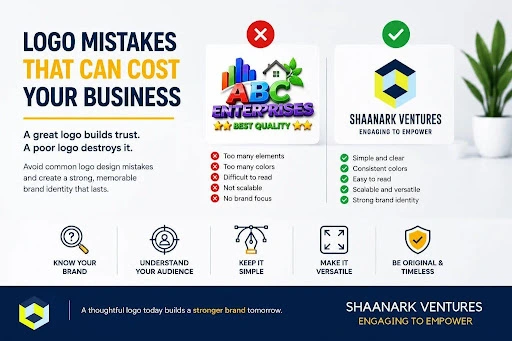
A logo is often the first impression people have of your business. It appears on your website, business cards, social media profiles, product packaging, advertisements, invoices, and every customer touchpoint. While it may seem like a simple graphic, a logo carries the responsibility of representing your brand’s identity, values, and professionalism.
Unfortunately, many businesses—especially startups and small enterprises—underestimate the importance of thoughtful logo design. They choose trendy designs, rely on generic templates, or create logos based solely on personal preference rather than strategic branding. The result is a logo that fails to connect with customers, weakens brand recognition, and can even damage credibility.
A well-designed logo is not just visually appealing; it is purposeful. It communicates who you are, what you stand for, and why customers should trust your business.
In this article, we’ll explore ten of the most common logo mistakes businesses make and how avoiding them can help build a stronger, more memorable brand.
1. Following Trends Instead of Building a Timeless Identity
Design trends come and go. A logo that looks modern today may feel outdated in just a few years.
Many businesses are tempted to use popular design styles simply because they are fashionable. While trends can provide inspiration, they should never dictate your brand identity.
A timeless logo remains relevant for years without requiring frequent redesigns. Think of globally recognized brands—their logos have evolved gradually while retaining their core identity.
Instead of chasing trends, focus on creating a design that reflects your company’s mission, personality, and long-term vision.
2. Making the Logo Too Complicated
One of the biggest mistakes businesses make is trying to include too much information in a logo.
Complex illustrations, excessive colors, intricate patterns, and multiple fonts make a logo difficult to recognize and remember.
The most effective logos are often the simplest.
A clean design is easier to reproduce across different media, from business cards to large billboards. It also helps customers identify your brand instantly.
Remember: simplicity creates memorability.
3. Choosing the Wrong Colors
Colors influence emotions and purchasing decisions more than many business owners realize.
Every color communicates something different:
- Blue suggests trust, professionalism, and reliability.
- Green often represents growth, sustainability, and health.
- Red conveys passion, excitement, and energy.
- Black communicates sophistication and authority.
- Orange reflects creativity and enthusiasm.
Selecting colors based purely on personal preference rather than brand strategy can confuse your audience.
Choose a color palette that aligns with your industry, target audience, and brand values.
4. Using Too Many Fonts
Typography plays a crucial role in logo design.
Using several fonts in one logo creates inconsistency and reduces readability. It also makes the logo appear cluttered and unprofessional.
Most successful logos use one carefully selected typeface or, at most, two complementary fonts.
The font should match your brand personality. A law firm requires a very different style of typography than a children’s education company or a creative agency.
Consistency always wins over complexity.
5. Ignoring Scalability
Your logo will appear in many different sizes.
It may be displayed as:
- A website favicon
- A social media profile picture
- A business card
- Company stationery
- Uniforms
- Product packaging
- Vehicle branding
- Exhibition banners
If the logo loses clarity when resized, it is not serving its purpose.
A professional logo should remain recognizable whether it is printed at 20 millimetres or displayed across a large outdoor sign.
Testing scalability during the design process is essential.
6. Copying Competitors
It can be tempting to imitate successful brands within your industry.
However, copying a competitor’s visual identity creates confusion and weakens your own market position. It may also expose your business to legal and trademark risks.
Your logo should highlight what makes your business unique.
Authenticity builds trust.
Customers appreciate brands with distinct identities rather than businesses that look like everyone else.
7. Designing Without Understanding the Brand
Many logos are created before businesses clearly define their identity.
A designer should first understand:
- The company’s vision
- Target audience
- Industry positioning
- Core values
- Competitive advantages
- Brand personality
Only then can a logo effectively represent the business.
A logo designed without strategy becomes merely decoration rather than a branding asset.
Great logo design always begins with discovery and research.
8. Ignoring Versatility
A logo must perform consistently across both digital and physical platforms.
Ask yourself:
Will it work in black and white?
Can it be embroidered on clothing?
Will it remain clear on mobile devices?
Does it look professional on a dark background?
Can it be used without losing quality in print?
Professional designers create multiple logo variations to ensure flexibility in every application.
Versatility saves businesses from future branding challenges.
9. Using Low-Quality Artwork
Many businesses begin with logos created using free online generators or low-resolution graphics.
While these may appear acceptable on a computer screen, problems quickly arise when printing brochures, banners, signage, or promotional materials.
Professional logos should always be designed as vector graphics.
Vector files allow unlimited resizing without losing quality, ensuring consistent branding across every platform.
Investing in professional artwork prevents expensive redesigns later.
10. Treating the Logo as the Entire Brand
Perhaps the biggest misconception is believing that a logo alone creates a brand.
In reality, a logo is only one component of a much larger branding system.
A complete brand also includes:
- Brand strategy
- Messaging
- Visual identity
- Color palette
- Typography
- Photography style
- Tone of voice
- Customer experience
- Marketing communication
Even the best-designed logo cannot compensate for inconsistent branding.
Successful companies ensure every customer interaction reflects the same identity and values.
A logo introduces your brand; your overall experience defines it.
Why Professional Logo Design Matters
A professionally designed logo does far more than look attractive.
It helps businesses:
- Build credibility
- Increase customer trust
- Improve brand recognition
- Differentiate from competitors
- Create emotional connections
- Support marketing efforts
- Enhance perceived value
- Strengthen long-term brand equity
Customers often judge a company’s professionalism within seconds of seeing its visual identity.
A thoughtful logo can create confidence before a single conversation takes place.
How the Right Logo Supports Business Growth
As businesses grow, their branding becomes increasingly important.
A strong logo provides consistency across every customer touchpoint—from websites and presentations to social media, advertisements, packaging, and office signage.
It becomes a visual shortcut for your company’s reputation.
Every positive customer experience strengthens the association between your logo and your brand promise.
Over time, that recognition becomes one of your most valuable business assets.
Conclusion
Your logo is far more than a graphic—it is the face of your business. It communicates your professionalism, values, and personality long before you have the opportunity to speak with a potential customer.
Avoiding common logo mistakes such as following short-lived trends, overcomplicating the design, choosing inappropriate colors, or overlooking scalability can significantly strengthen your brand’s impact.
A strategic, well-crafted logo helps build trust, improves recognition, and lays the foundation for long-term business success.
At Shaanark, we believe every successful brand begins with a strong identity. Our branding experts combine creativity with business strategy to design logos that are not only visually compelling but also aligned with your company’s vision, audience, and growth objectives.
Because a great logo doesn’t just help people remember your business—it gives them a reason to trust it.